The primary objective of the Trust is to promote the Arts
The Trust was modestly endowed by Evelyn Williams and her husband and has received support from individuals. The Trustees are responsible for the care of all works by Evelyn Williams, which were willed to them on her death.
“I like the idea that any money that comes out of my Estate will help some other artist when I am no longer around.” – Evelyn Williams
The Trust was set up in 1991 when Evelyn Williams was in her mid-sixties. Initially, the focus was on the discipline of drawing, particularly through the encouragement of young and emerging artists. “At that time there was, as far as I could see, no drawing going on in art schools,” said Evelyn. “By drawing, I don’t mean just drawing from the model, I mean making plans for what you’re going to do. It’s a process of thinking; it starts in your head and it comes out in your hands, in whatever medium you happen to be using. It is fundamental to all good art.”
Since Evelyn’s death, the Trust has been responsible for all her remaining works. All proceeds from sales go towards making awards to artists.
The Trustees
David Alston M.B.E. – formerly Arts Director, The Arts Council of Wales, 2006-18, now retired
Esmond Bridgeman – MegaScroll Ltd
Imogen Brown – Retired, (family member) Secretary and Treasurer for the Trustees
Rhian Kempadoo-Millar - Lead artist for Mango Arts, Collective of Freelancers
Juliet Moller – Milne and Moller
Nicholas Usherwood (Chair) – Curator and author
Robin Bynoe, associate board member - Solicitor, M Law LLP
We are always interested in speaking to anyone who would be interested in contributing to the work of the Trust through use of specific skills, knowledge of connections, either as a volunteer or as a trustee.
Robin Bynoe, associate board member, writes:
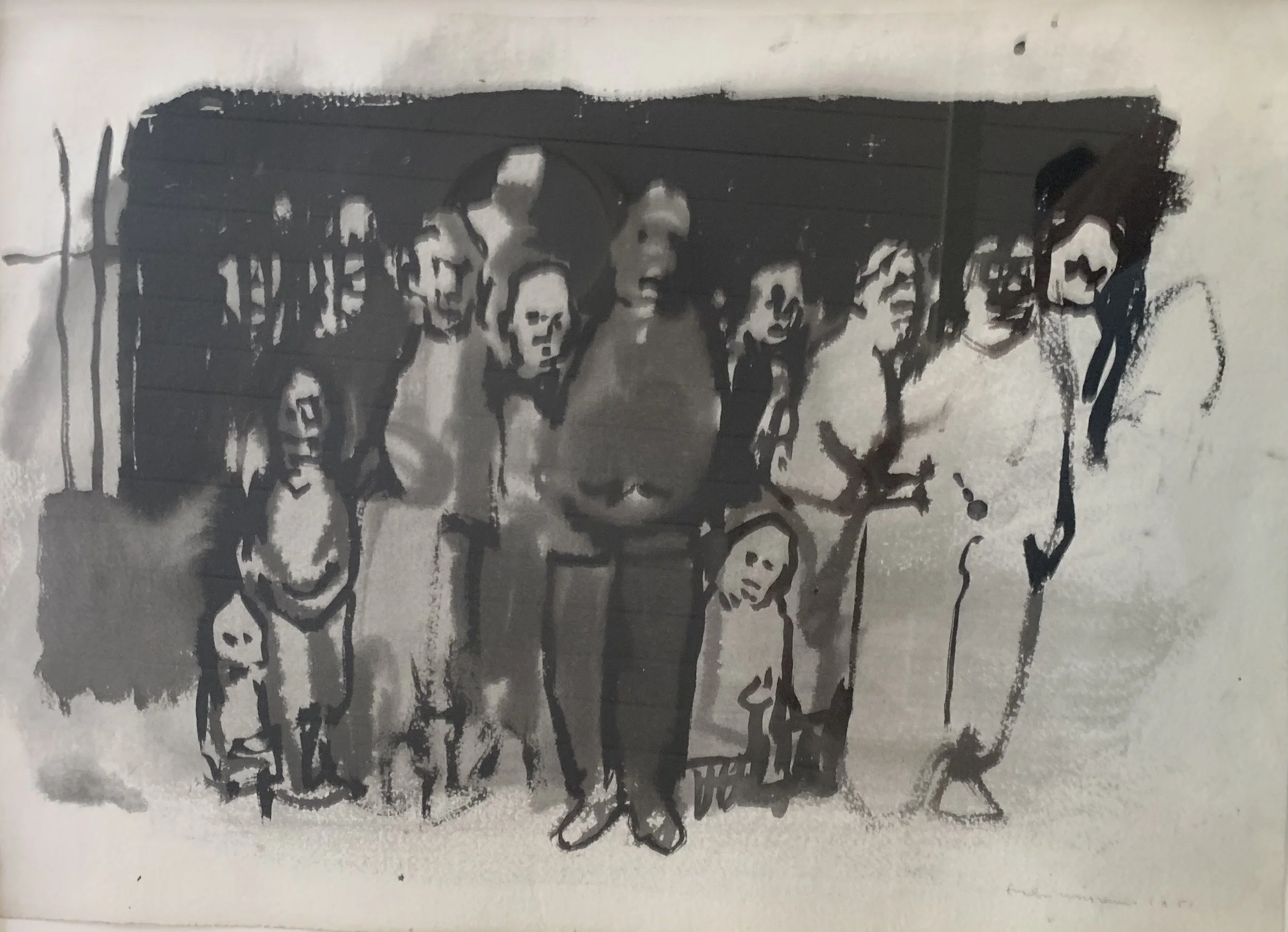
In 1972, Evie had a rather prestigious one-person show at the Whitechapel Callery in London. The theme of the show, if unadvertised as such, was loss, and a central painting was The Mourners, sometimes called ‘The Large Funeral Painting’. This painting is very dark – in every sense - and large: 40 x 60 inches. The scene is a Welsh hillside, where people stand distraught around a graveside.
Somebody bought it, and twenty years later it was in Christies’ secondary auction house at South Kensington, unframed, unheralded and estimated cheaply. I don’t think that it was even illustrated in the catalogue. I bought it, for not a lot of money; it only just fitted into the back of my car. I think that it is a major painting and I have always loved it. It did not find favour at home, however, for which it was thought to be too sombre.
I told Evie that I had bought the painting at auction. A shadow crossed her face.
‘Oh, that was you, was it?’
She had left a low bid with Christies but I had beaten her with a slightly less low one.
‘If you want it back, you should have it,’ I said. She brushed that aside.
‘But,’ she said, ‘I still have a couple of preparatory drawings that you might
be interested in.’
And she produced them after a bit of rummaging.
I said that I would buy them. I could hardly say anything else.
She announced a price which was approximately what I had paid for the large painting.
So clearly it had rankled, just a little.
The Mourners (big version) went off to storage at domestic insistence.
Years later, Evie very generously said that she would like to give me a painting of my choice. I agonised about that, because what I really loved more than any other was The Bound Men, a big and important work. I proposed to her that I had The Bound Men, and that I returned The Mourners (big version) to her; it was, I thought, a major and wonderful painting and it belonged with her and not in my storage, where no one would ever see it. She agreed.
The Bound Men hang over my dinner table, trying with varying degrees of pessimism to escape their lot. The Mourners (drawing) hangs unassumingly in my bedroom. Occasionally friends who can tell a work of art from a hole in the wall are taken on guided tours.
‘Of course that’s the best thing that you have,’ said one ‘I always want to see that one.’
From time to time people say the same thing about The Bound Men. You hear it from other owners of Evie’s work. A friend of mine once told me that he had a mother and child painting of Evie’s in his living room and that when his family came round they would always stand for a moment in contemplation and respect in front of this painting before doing anything else. He mentioned this to them and they said that they had not noticed; it was instinctive.
The Bound Men can be seen in the database of Evie’s work on the website. It is also in her book A Life’s Work. The Mourners for some reason cannot be found in the database, unless I am looking in the wrong place. Nor can the drawing illustrated here. There are still mysteries and wonders, despite our best efforts.
Copyright and Reproduction
Bridgeman Images has the exclusive rights to license any of Evelyn's works for reproduction
and a large number of her images are illustrated on their website.
For reproduction enquiries, please contact Bridgeman directly